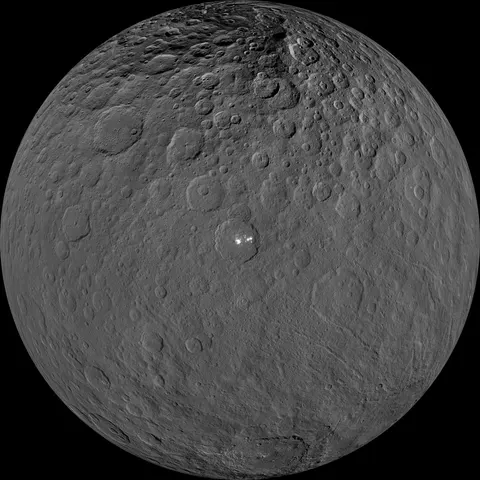
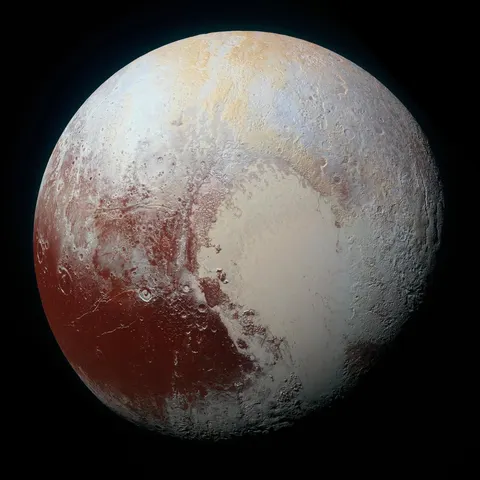
Beyond the planets, the Sun holds millions of smaller worlds. The International Astronomical Union recognises five dwarf planets: Ceres in the asteroid belt, and Pluto, Eris, Haumea and Makemake beyond Neptune. Several more icy bodies are probably large enough to qualify. Rubin Observatory is expected to find many more of them.
The largest object in the asteroid belt and the only dwarf planet in the inner Solar System. NASA’s Dawn spacecraft orbited it from 2015 to 2018 and found bright salt deposits in Occator Crater.
Found by Clyde Tombaugh in 1930 and reclassified as a dwarf planet in 2006. New Horizons flew past on 14 July 2015 and found nitrogen-ice plains, water-ice mountains and a hazy blue atmosphere.
Orbits, rotation and discovery details come from the JPL Small-Body Database. Daily positions and brightness come from JPL Horizons. Sizes are published estimates. The 3D views are Rubin Observatory’s Orbitviewer, which has pages for selected objects only; the others link to JPL’s orbit diagram. Photos are from NASA missions. No spacecraft has visited Eris, Haumea, Makemake or the candidates, so no close-up photos of them exist.
Data updated .
Where they are today
Positions for 2026-11-02 00:00 UTC, seen from Earth. Smaller magnitude means brighter.
Whole sky, right ascension (hours) across, declination (degrees) up. The dashed curve is the plane of the Milky Way.
1 au is the Earth–Sun distance, about 150 million km. Viewing hints are a rough guide for a dark site.
Asteroid alerts this week
255 alerts in the last 7 days were classified as asteroids. Each is a machine-learning guess from a single image, and most are not yet matched to a known object. Naming them, by checking which known asteroid was at that spot at that moment, is coming next.